

FUE vs. DHI Hair Transplant? Which Method is Right for Whom?

FUE vs. DHI Hair Transplant? Which Method is Right for Whom?
When embarking on a hair transplant journey, the most fundamental technical distinction patients encounter is between the FUE and DHI methods. Both methods are based on the principle of healthily harvesting hair follicles (grafts) from the donor area (usually the nape). However, the fundamental difference between these two advanced techniques is not how the grafts are harvested, but how they are implanted. This implantation difference directly affects the operation’s duration, cost, recovery speed, and, most importantly, the maximum density that can be achieved. This guide objectively compares the FUE and DHI techniques to help you make the right decision.
Before making your decision, it is important to understand the basic mechanics of both methods. Choosing the wrong technique can lead to your expectations not being met or your valuable donor resources being used inefficiently.
Part 1: Technical Differences – Channel Opening vs. Direct Implantation
In both methods, the grafts are generally harvested one by one using the FUE (Follicular Unit Extraction) method, i.e., with a micro-motor. The real difference begins at the stage where these grafts are placed into the recipient area.
Traditional FUE (or Sapphire FUE): Two-Stage Implantation
In the FUE technique, the implantation process occurs in two separate steps:
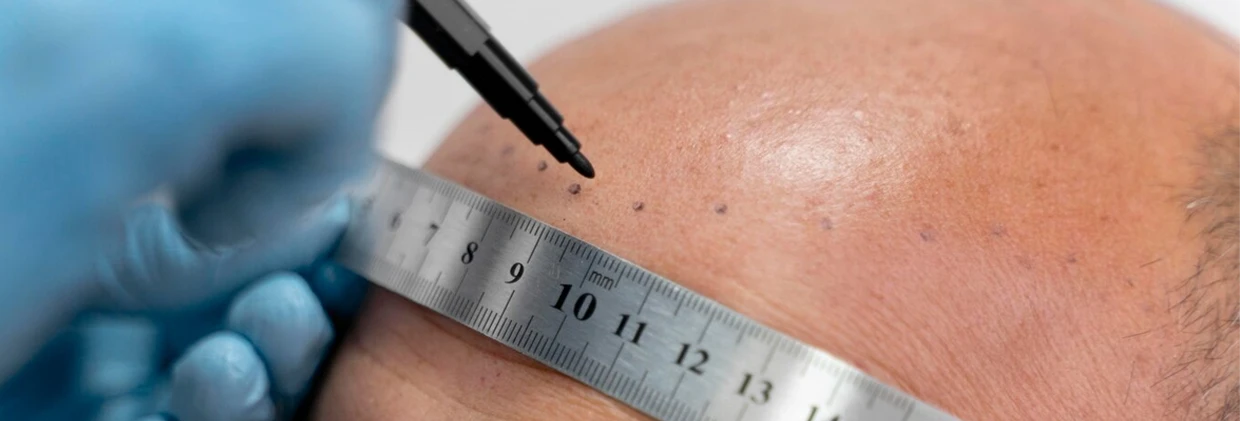
- Channel Opening: The surgeon first opens micro-incisions (channels) in the recipient area using special metal “slits” or more modern “Sapphire” blades, matching the number of grafts harvested. The angle, direction, and frequency of these channels determine the naturalness of the result.
- Placement: Assistants or the surgeon then place the harvested grafts one by one into these pre-opened channels using medical forceps (tweezers).
DHI (Direct Hair Implantation): Single-Stage Implantation (Pen Technique)
In the DHI technique, as the name implies, the implantation is “direct.” This process is made possible by a special medical instrument called the Choi Implanter Pen:
- Channel Opening and Implantation Simultaneously: The harvested grafts are placed into the hollow needle of the Choi pen.
- The moment the surgeon inserts this pen directly into the skin, the tip of the pen both opens the channel and releases the graft under the skin by pressing the plunger.
In other words, there is no separate channel-opening process in DHI. The channel for each follicle is opened at the moment of implantation. This is the most fundamental and revolutionary difference of DHI.
Part 2: Comparative Analysis – Where Does Each Technique Excel?
These two different application philosophies create advantages and disadvantages in various aspects of the operation.
1. Density (Dense-Packing)
- FUE: Since the channels are opened in advance, the surgeon must leave a certain “safe distance” between the channels to avoid risking tissue trauma and blood circulation. This limits the number of grafts that can be placed per cm².
- DHI: Because channel opening and implantation are done simultaneously, tissue trauma is minimal, and bleeding is less, grafts can be implanted much closer to each other with the DHI pen. This allows DHI to be superior to FUE, especially in “dense-packing”.
2. Shaving Requirement
- FUE: For the surgeon to clearly see the thousands of channels they have opened and to place the grafts, complete shaving of the recipient area is generally mandatory.
- DHI: The Choi pen can easily insert grafts between existing long hairs. Therefore, DHI is the most ideal and safest method for an unshaven hair transplant. This is a huge advantage, especially for female patients and professionals who do not want to take a break from their social lives.
3. Recovery Speed and Trauma
- FUE: The channel opening process, by its nature, creates more incisions and a larger trauma area. This can mean more bleeding, more significant scabbing, and a slightly longer recovery period post-operation.
- DHI: Since only a needle-tip entry is made, tissue trauma is minimal. Bleeding is much less, scabbing is minimal, and the recovery process is faster and more comfortable compared to standard FUE.
4. Operation Duration and Cost
- FUE: The channel opening process is relatively fast. Therefore, for large-area operations requiring a very high number of grafts (e.g., 3500+), FUE is often a faster and more cost-effective solution.
- DHI: Placing each graft into the pen one by one and implanting them individually is a slower process that requires high manual labor and concentration. This extends the operation time, and due to the cost of the special (often disposable) Choi pens, the DHI technique is a higher investment compared to FUE.
Part 3: Decision Guide – Which Method is Right for Whom?
In light of this comparison, you can decide which method is more suitable for you:
FUE (Sapphire FUE) is Ideal for You If:
- Your transplant area is very large and you need a high number of grafts (e.g., over 3500).
- Completely shaving your head for the operation is not a problem for you.
- You are looking for a permanent solution compared to non-surgical treatments but prefer a more budget-friendly (cost-effective) option.
DHI is Ideal for You If:
- Your hair is not completely gone, and your main goal is densification (dense-packing) between existing hairs.
- You do not want the operation to be noticeable and wish to have an unshaven hair transplant (e.g., female patients, executives, people with active social lives).
- You have smaller, sensitive areas to be transplanted that require millimetric angle and direction control, such as the frontal hairline, temples, beard, or eyebrows.
- You prioritize the fastest and most comfortable recovery process.
In conclusion, there is no “best” method, only the “right” method for you. This decision is not just about the technique but also about the surgeon’s expertise. A bad surgeon can fail with DHI, and a master surgeon can create wonders with FUE. Organizations like the International Society of Hair Restoration Surgery (ISHRS) also emphasize the importance of the surgeon’s experience and proper patient selection, regardless of the technique.
As Görkem Kazan Hair Transplant, our team, specialized in both techniques, first determines your needs by performing a detailed hair analysis. We present you with the technique that will give you the most accurate, safest, and most natural result, along with all its advantages and disadvantages, and we make the decision together. You can contact us to get an expert opinion during this important decision-making process.